Parameterized Families of Elliptic Curves with Large Rational Torsion Subgroups
Elliptic Curves and the Group Law
An elliptic curve $\mathcal{E}$ defined over the rationals $\mathbb{Q}$ is a smooth curve of genus 1 with at least one rational point. In the affine chart, we typically describe it by a generalized Weierstrass equation:
where $a_i \in \mathbb{Q}$. One of the beautiful features of elliptic curves is that the set of rational points $\mathcal{E}(\mathbb{Q})$ carries a natural group law that can be described geometrically using the chord-and-tangent method: to "add" two points, draw a line through them, find the third intersection with the curve, and reflect across the $x$-axis. The identity element for this group is the point at infinity $\mathcal{O}$.
Two points sum to $\mathcal{O}$ when they lie on the same vertical line. A point $P$ has finite order $n$ if $[n]P = P + P + \cdots + P$ ($n$ times) $= \mathcal{O}$, and $n$ is the smallest positive integer for which this is true. The set of all finite-order points is called the torsion subgroup, denoted $\mathcal{E}_{\text{tors}}(\mathbb{Q})$.
Mazur's Theorem
A natural question to ask is: how large can the torsion subgroup be? The answer comes from a famous theorem of Barry Mazur. If $P \in \mathcal{E}_{\text{tors}}(\mathbb{Q})$, then the order of $P$ must be in the set $\{2, 3, 4, 5, 6, 7, 8, 9, 10, 12\}$. Notably, order 11 is not possible.
Moreover, it is a classical result that for each $n \in \{4, 5, 6, 7, 8, 9, 10, 12\}$, the set of all elliptic curves over $\mathbb{Q}$ having a rational point of order $n$ lies in a one-parameter family. Specifically, any such curve $\mathcal{E}$ with a rational point of order $n \geq 4$ at $(0,0)$ is birationally equivalent to a curve in Tate normal form:
where $v, w \in \mathbb{Q}$. By using the group law to compute $[n](0,0) = \mathcal{O}$ and extracting the relation between $v$ and $w$, each torsion order gives a one-parameter family:
where $f_n(t)$ and $g_n(t)$ are rational functions of a single parameter $t \in \mathbb{Q}$. Here are the parameterizations:
| $n$ | $f_n(t)$ | $g_n(t)$ |
|---|---|---|
| 4 | $1$ | $t$ |
| 5 | $t+1$ | $t$ |
| 6 | $1-t$ | $-t(t+1)$ |
| 7 | $1-t-t^2$ | $t^2(t+1)$ |
| 8 | $\dfrac{-2t^2+1}{t+1}$ | $-t(2t+1)$ |
| 9 | $t^3+t^2+1$ | $t^2(t^3+2t^2+2t+1)$ |
| 10 | $1 - \dfrac{t^3+3t^2+2t}{t^2+6t+4}$ | $\dfrac{t^5+3t^4+2t^3}{t^4+12t^3+44t^2+48t+16}$ |
| 12 | $\dfrac{6t^4-8t^3+2t^2+2t-1}{t^3-3t^2+3t-1}$ | $\dfrac{-12t^6+30t^5-34t^4+21t^3-7t^2+t}{t^4-4t^3+6t^2-4t+1}$ |
So for any integer value of $t$ (and the right torsion order $n$), you get a concrete elliptic curve with a rational torsion point of order $n$ at $(0,0)$. Plug in $t = 2$ and $n = 4$, for instance, and you get $\mathcal{E}: y^2 + xy + 2y = x^3 + 2x^2$, which has a rational point of order 4 at the origin.
Interactive Demonstration
I built a Wolfram Demonstration that lets you explore these families interactively. Pick a torsion order $n$, vary the parameter $t$, and watch the curve change shape. The red dots are the torsion points, and if you enable "show group law lines," the yellow lines illustrate the chord-and-tangent additions $[k](0,0)$ for $1 \leq k < n$, with the orange vertical line marking the final sum $[n](0,0) = \mathcal{O}$.
Snapshots
Here are some snapshots from the Demonstration showing different torsion orders and the geometric group law:
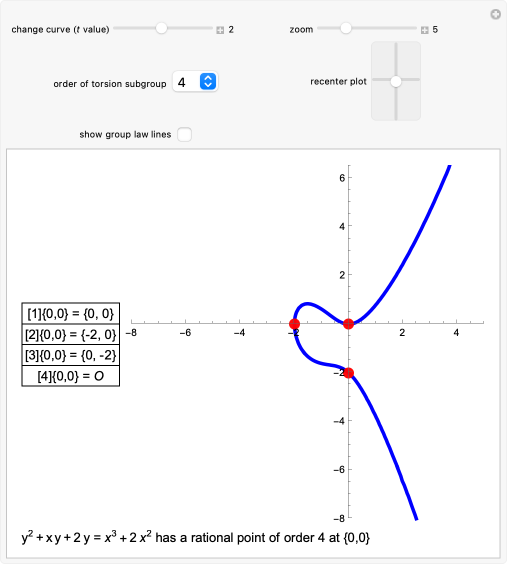
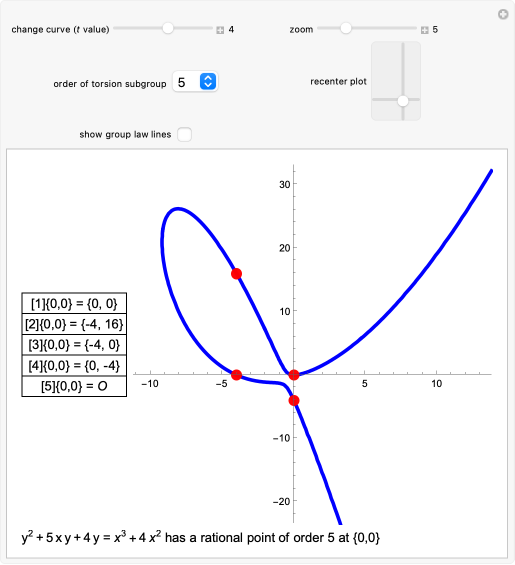
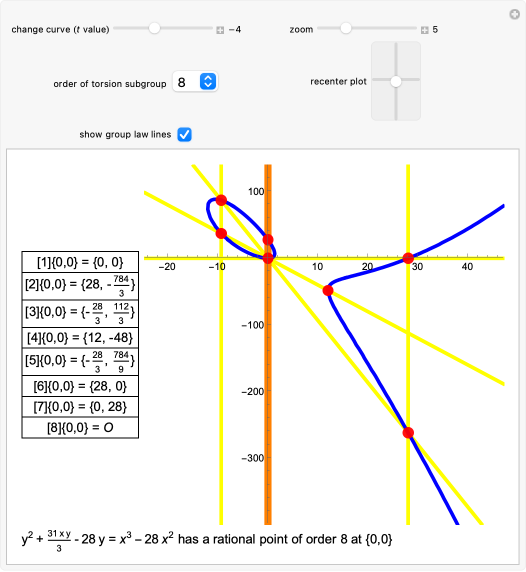
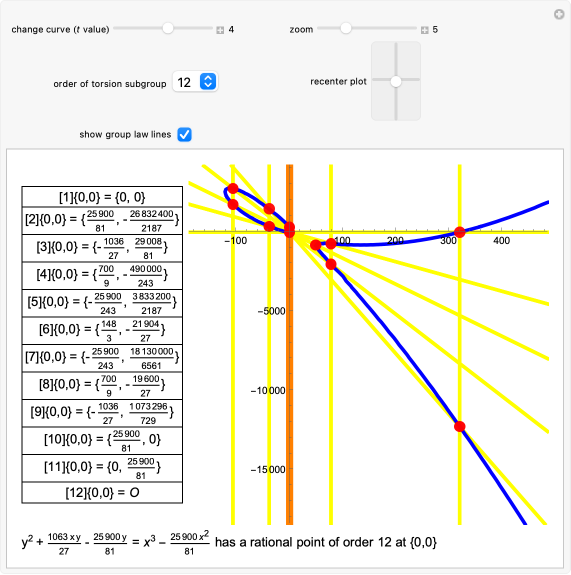
Notice how the group law lines in the order-8 and order-12 snapshots create a visual web connecting the torsion points. Each yellow line represents one step of the chord-and-tangent addition, and the vertical orange line is the final step where the running sum lands on a point that shares a vertical line with the previous one, sending the total to $\mathcal{O}$.
Applications in Number Theory
By the Mordell-Weil theorem, the group of rational points on an elliptic curve is finitely generated: $\mathcal{E}(\mathbb{Q}) \cong \mathcal{E}_{\text{tors}}(\mathbb{Q}) \times \mathbb{Z}^r$. Mazur's theorem pins down the torsion part completely, but computing the integer $r$ (the rank) remains a fundamental open problem. There is no known algorithm that is guaranteed to compute the rank of an arbitrary elliptic curve.
The standard approach to bounding the rank is a 2-descent, which computes the 2-Selmer group. A 2-descent determines the rank only when the 2-part of the Tate-Shafarevich group $\Sha$ is trivial, and there is no guarantee that it will be.
When a curve has a rational torsion point, one can use Vélu's formulas to construct an explicit isogeny $\phi : \mathcal{E} \to \hat{\mathcal{E}}$ of degree $d$ matching the torsion order, along with the dual isogeny $\hat{\phi}$. The resulting $\phi$-Selmer and $\hat{\phi}$-Selmer groups provide an alternative descent that can succeed where a 2-descent fails, for instance by detecting nontrivial elements of the $d$-part of $\Sha$ or by pinning down the rank via a $d$-isogeny when the 2-part is obstructed. The one-parameter families above give a natural supply of curves to which this technique applies.
Further Reading
The parameterizations in the table above are derived using the technique from Vélu's 1971 paper, "Isogénies entre courbes elliptiques." For a thorough treatment of elliptic curves and descent, Silverman's The Arithmetic of Elliptic Curves is the standard reference. The paper by E.V. Flynn and C. Grattoni, "Descent via Isogeny on Elliptic Curves with Large Rational Torsion Subgroups," applies these families to perform explicit descents via isogenies of degree $d \in \{4, 5, 7, 8, 9\}$, including PARI implementations and worked examples.
← Back to Blog