The Riemann Sphere as a Stereographic Projection
The Riemann Sphere and the Extended Complex Plane
The Riemann sphere is a geometric representation of the extended complex plane $\hat{\mathbb{C}} = \mathbb{C} \cup \{\infty\}$, the complex numbers with an added point at infinity. Compactifying $\mathbb{C}$ this way (a one-point compactification of a topological space into a compact space) gives meromorphic functions a natural home: a pole of $f$ at $z_0$ just means $f(z_0) = \infty$ on $\hat{\mathbb{C}}$.
To visualize this compactification, we perform a stereographic projection of the unit sphere onto the complex plane. For each point in the $z$ plane, draw a line from $z$ to a designated point on the sphere; the line intersects both the sphere and the plane exactly once.
The Projection
In this Demonstration, the construction lives in $\mathbb{R}^3$ with the plane at $z = 0$ representing $\mathbb{C}$. The unit sphere is centered at $(0, 0, 1)$, and the stereographic projection is from the "north pole" of the sphere at $N = (0, 0, 2)$.
Given a point $(x_0, y_0, z_0)$ on the unit sphere, parameterize the line from $N$ through that point:
Setting $z = 0$ and solving $0 = 2 + t(z_0 - 2)$ gives the value of $t$ at which the line hits the plane. The image $L_1\!\left(\frac{-2}{z_0 - 2}\right)$ is the projected point.
An alternative construction centers the unit sphere at the origin and projects from $(0,0,1)$. Either way, the result is a conformal map with a designated "point at infinity" at the north pole.
Key Geometric Properties
Stereographic projection is conformal: it preserves angles between curves. A pair of curves meeting at some angle on the sphere will meet at the same angle in the plane.
It also maps circles on the sphere to circles or lines in the plane. A circle on $S^2$ that passes through the north pole projects to a straight line (a "circle of infinite radius"), while every other circle projects to a circle. The Demonstration lets you see this directly: set "show curve" to "circle" and enable "projection lines on curve" to watch the projection lines from $N$ through the circle on the sphere down to the corresponding circle in the plane.
The "Unwrap Sphere" Slider
To animate the projection, the Demonstration defines a one-parameter family of surfaces. Rescale $L_1(t)$ so that $L_2(0) = (x_0, y_0, z_0)$ and $L_2(1)$ is the projected point on the plane. Then parameterize the sphere using cylindrical coordinates $(x(u,v), y(u,v), z(u,v))$ and define:
At $s = 0$ this is the unit sphere; at $s = 1$ it is the plane $z = 0$. Dragging the slider from 0 to 1 continuously deforms the sphere into the plane, visually illustrating the bijection.
Interactive Demonstration
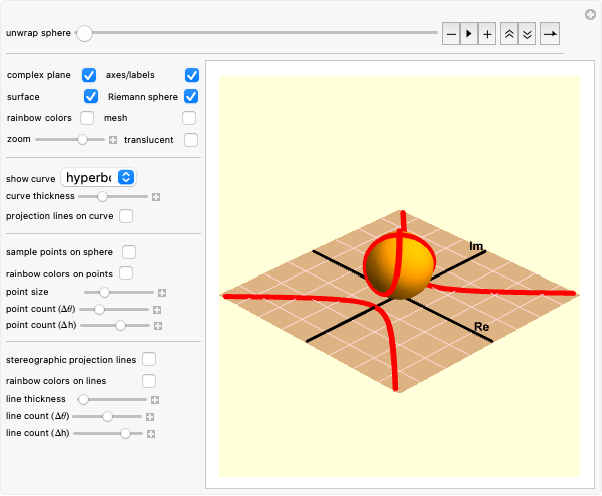
The Wolfram Demonstration lets you interact with this projection in several ways: "unwrapping" the sphere, showing stereographic projection lines, viewing the image of a set of points on the sphere under the projection, and picking a curve to view its image under the projection. The rainbow coloring on the sphere is a convenient visual tool for comparing where points on the sphere map to on the plane. You can plot a parabola or hyperbola to get geometric intuition about the "point at infinity."
Snapshots
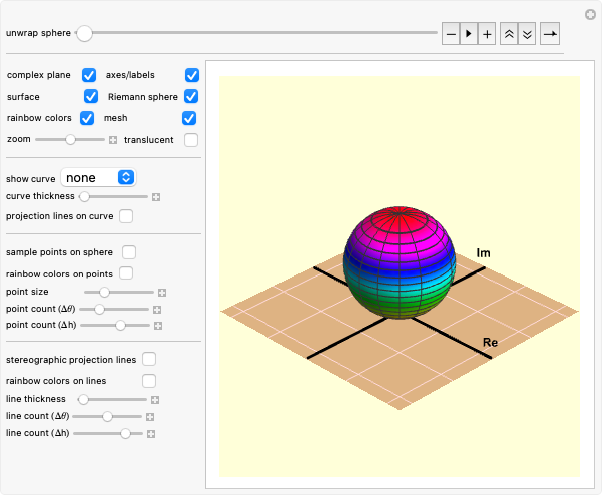
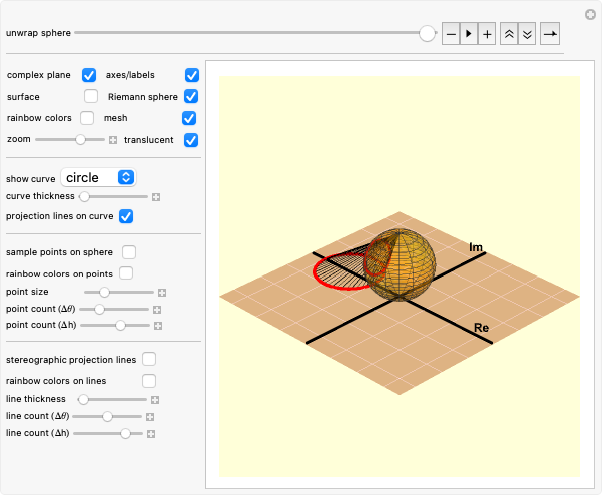
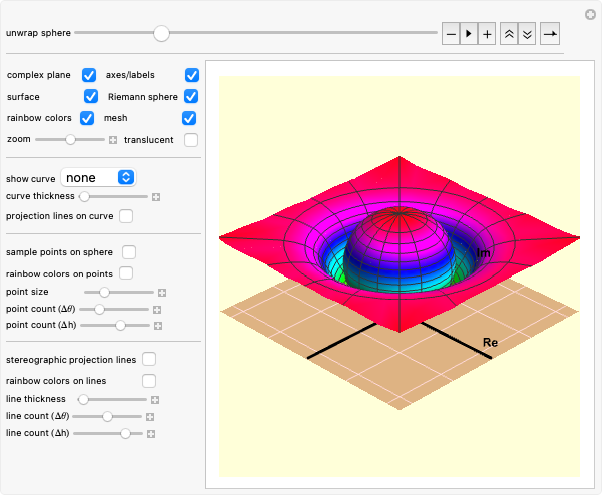
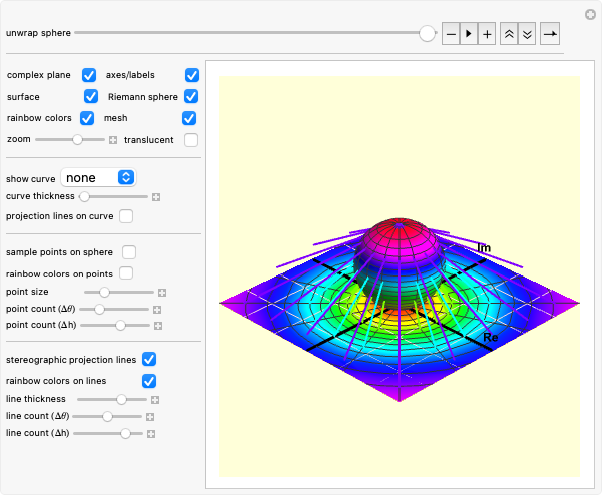
A hyperbola mapped onto the sphere passes through the north pole, since the asymptotes go to infinity. This gives geometric intuition for the "point at infinity" on $\hat{\mathbb{C}}$:
Where This Comes Up
The Riemann sphere appears throughout complex analysis and algebraic geometry. Möbius transformations $z \mapsto \frac{az + b}{cz + d}$ are automorphisms of $\hat{\mathbb{C}}$, and they correspond to rotations and other rigid motions of $S^2$. In algebraic geometry, $\hat{\mathbb{C}}$ is the complex projective line $\mathbb{P}^1(\mathbb{C})$, the simplest example of a projective variety. Rational functions on $\hat{\mathbb{C}}$ are the meromorphic functions, and every compact Riemann surface admits a nonconstant meromorphic function, making the Riemann sphere the base case in the classification of Riemann surfaces.
← Back to Blog